

Engineering Scalable Data Warehouse Solutions
HiFX helps enterprises build scalable cloud-native data warehouse ecosystems that unify enterprise data, accelerate analytics, and enable intelligent decision-making through secure, high-performance, and future-ready data architectures.Talk to Us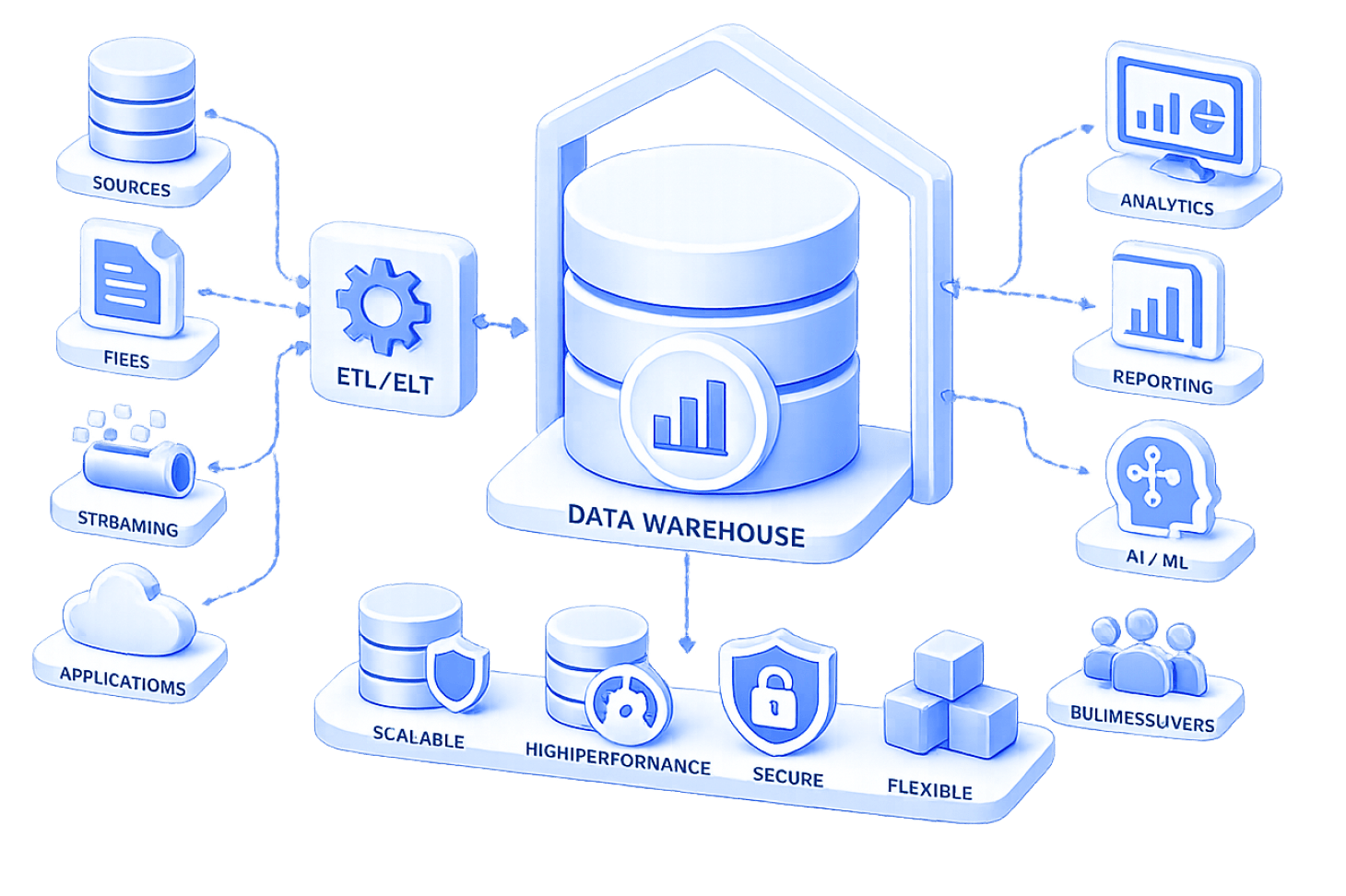
Modern Data Warehousing. Built for Intelligence.
We design warehouse schemas around how the business actually asks questions — dimensional modeling with clear fact and dimension tables, rather than a flat copy of source system tables. That distinction is the difference between a warehouse that answers a new business question in an afternoon of SQL and one that needs a new pipeline built every time someone asks something that wasn't pre-aggregated.
 Dimensional Data Modeling
 Query-Pattern-Driven Design
 Star Schema Architecture
Full-Spectrum DevOps Engineering Services

Cloud Data Warehousing
We design around star or snowflake schema depending on query complexity — star schema for faster, simpler queries on well-understood dimensions; snowflake where normalization reduces redundancy on large, evolving dimension tables.

ETL & Data Pipelines
We default to ELT over ETL where the target warehouse (Snowflake, for instance) has strong compute for transformation — load raw data first, transform inside the warehouse using SQL, which is easier to audit and iterate on than transformation logic buried in a pipeline tool.

Data Modernization
Legacy warehouse migrations usually surface undocumented business logic buried in old ETL jobs — calculations nobody wrote down anywhere else. We treat discovering and documenting that logic as part of the migration, not an afterthought.

Business Intelligence Solutions
We build a semantic layer between the warehouse and BI tools so that a metric like 'active customer' is defined once and used consistently — rather than every dashboard builder defining it slightly differently in their own queries.

Data Governance & Security
Access control is designed at the schema and role level from the start — who can see raw PII vs. aggregated metrics — rather than granting broad warehouse access and restricting later, which is harder to audit and easier to get wrong.

Real-Time Analytics Platforms
Where genuine real-time visibility is needed (not just frequent batch refreshes), we evaluate streaming ingestion — Kafka or Kinesis feeding directly into the warehouse — against the added operational complexity it introduces.
Our Process

Discovery
Interview the actual report and dashboard consumers to understand query patterns, not just the source systems — the schema should be designed around how data gets asked for.

Architecture
Dimensional model design (star or snowflake) reviewed against those query patterns before any pipeline gets built.
Integration
Build ETL/ELT pipelines with data quality checks at ingestion, so bad data gets caught before it reaches reporting layers.
Optimization
Monitor query performance against real usage and adjust indexing, partitioning, or materialized views based on what's actually slow.
Transforming Businesses Through Technology
Mobile Application & Admin Panel
HiFX designed and developed a scalable mobile application and centralized admin panel for a leading national bakery and café chain, simplifying operations and improving customer accessibility.
 ·
· ·
· ·
· ·
· ·
·

Lens
HiFX designed and developed a digital platform to simplify lens inventory management, improve operational efficiency, and enable real-time visibility across retail operations.
 ·
· ·
· ·
· ·
· ·
·
Payment Application
HiFX designed and developed a secure payment application to simplify digital transactions, improve operational efficiency, and deliver seamless payment experiences through scalable cloud-native infrastructure.
··

Single Sign On
HiFX designed and developed a centralized Single Sign-On solution to streamline authentication workflows, improve security, and deliver seamless access management across enterprise applications and platforms.
· ·
· ·
· ·
· ·
·
Questions We Get Asked
Dimensional warehouse design (star or snowflake schema), ETL/ELT pipeline development, and a semantic layer that keeps metric definitions consistent across BI tools.
Yes — including surfacing and documenting business logic that's often buried undocumented in old ETL jobs, which is usually the hardest part of a migration.

